
OUR STORY · 1909–1912
When the Wisconsin River RoseBuilding the Rothschild Dam and Mill
As hundreds of people looked on with anticipation, the Wisconsin River began to rise behind a newly constructed dam beside the Marathon Paper Mill, which would later become Domtar’s Rothschild Mill. Workers closed the final gate of the dam on Sept. 10, 1910. In the following days, hundreds would flock to the area to watch Lake Wausau take shape.
Lake Wausau would help transform the region, but the adjoining mill — which would eventually become Domtar’s Rothschild Mill — carried economic promise that would carry Rothschild into the 21st century.
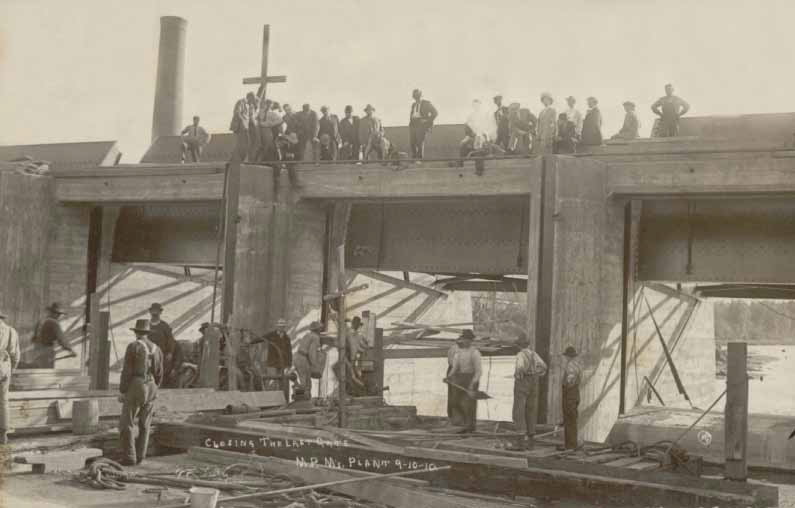
Workers and civilians watch as the dam’s last gate is closed on Sept. 10, 1910.
Visitors “saw the many possibilities for making Lake Wausau a beautiful and recreative summer resort.”
Wausau Daily Record-Herald · Sept. 12, 1910
Key Dates in the Mill’s Creation
- Early 1909The Wausau Group first meets after a state ruling requires water-power rights to be used or lost.
- Feb. 3, 1909Marathon Paper Mills Company is incorporated.
- May 1909Construction begins on the dam. Work on the mill buildings follows in July.
- Spring 1910D.C. Everest is named the mill’s first general manager.
- Sept. 10, 1910Workers close the dam’s final gate, and Lake Wausau begins to take shape.
- Nov. 18, 1910The No. 2 paper machine produces the mill’s first paper.
- Jan. 1911The mill is fully operational with three paper machines.
- Oct. 1911 – 1912Floodwaters force crews to dynamite about 400 feet of the dam. Rebuilding carries into 1912.
Harnessing the Wisconsin River
It took a group of area business and lumber leaders, known as the Wausau Group, about two years to go from concept to a fully operational complex.
The group first met in early 1909 after the Wisconsin Legislature ruled that holders of state-granted water-power rights on navigable streams must use those rights or risk losing them.
Some members considered a generating station or sawmill on the site. Instead, Neal Brown, a leader in the founding of Wausau Insurance Companies, proposed a paper mill.
The group selected a site on the Wisconsin River five miles south of Wausau, purchasing land from the Rothschild Power Company. Marathon Paper Mills Company was incorporated on Feb. 3, 1909, and construction on the dam began in May of that year. The mill buildings followed in July.

Original blueprint of the Marathon Paper Mill. Click to enlarge.
Construction was a “formidable task,” according to David Clark (D.C.) Everest, who was named the mill’s first general manager in spring 1910.
Everest recalled that crews had only one piece of mechanized equipment: a steam shovel. Workers handled nearly everything else manually or transported it by horse amid brutally cold winters and scorching summers.
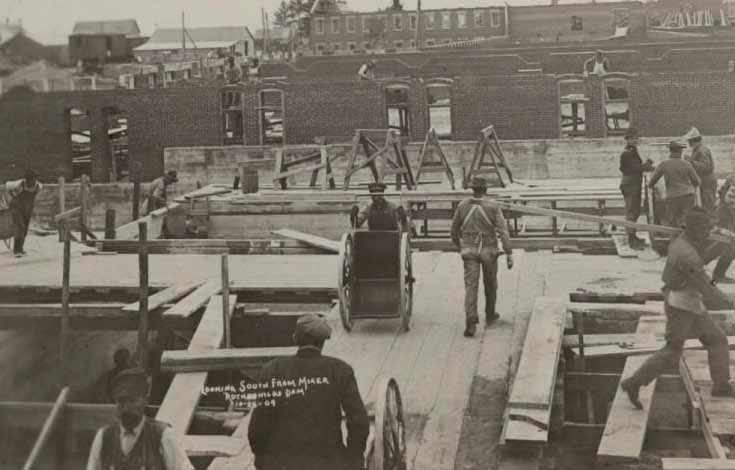
Laborers haul materials during the construction of the mill.
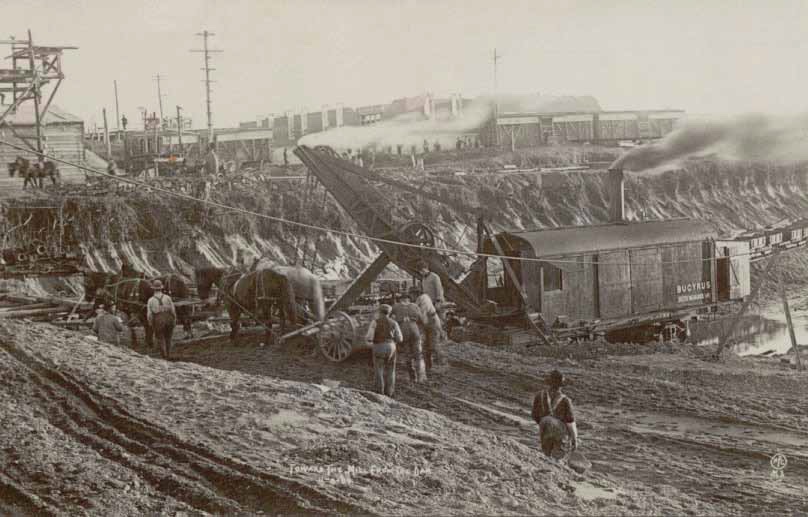
A steam shovel is used while constructing the Marathon Paper Mill.
Labor camps housed the large number of construction workers. The company eventually built permanent homes for mill employees, which would become the Village of Rothschild.
The water held back by the dam drove turbines that generated electricity for what some reports considered one of the nation’s most advanced mills of its time. Once the mill was completed, it could produce multiple kinds of pulp and a range of paper products.
The mill’s No. 2 paper machine produced its first paper on Nov. 18, 1910, and by January 1911, the mill was fully operational with three paper machines.
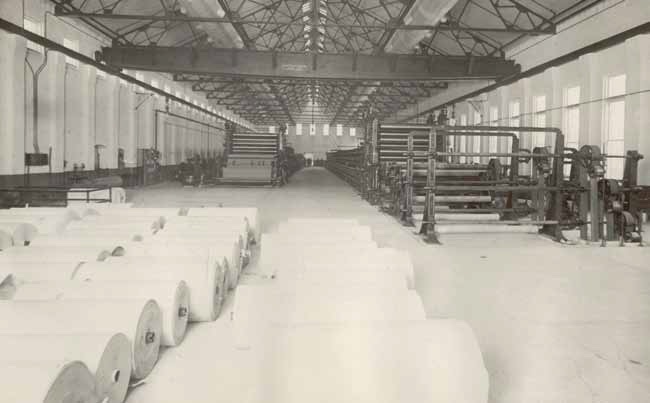
The original paper machines at the Marathon Paper Mill. The No. 2 paper machine is on the left; No. 1 paper machine is on the right.
A Mill Built by Hand
The Mill’s Early Days
As the mill approached its full production capacity, local newspaper reports pointed to its emerging role as a job creator and economic anchor.
The Wausau Daily Record-Herald stated that full production would require “many skilled men” across the mill’s departments and predicted Rothschild employee housing to nearly double.
In October 1911, that progress was nearly undone as heavy flooding threatened to destroy the mill. To divert the floodwaters, workers were forced to dynamite approximately 400 feet of the dam.
The flood caused an estimated $200,000 in damage, but the mill’s paper machines would be re-fired weeks later. In July 1912, another flood interrupted the dam’s extension and re-construction efforts.
Repairs took several months, but once completed, the new dam became the foundation that has maintained Lake Wausau for more than a century.

The scale of the dam rebuilding project after the 1911 flood, Feb. 8, 1912.
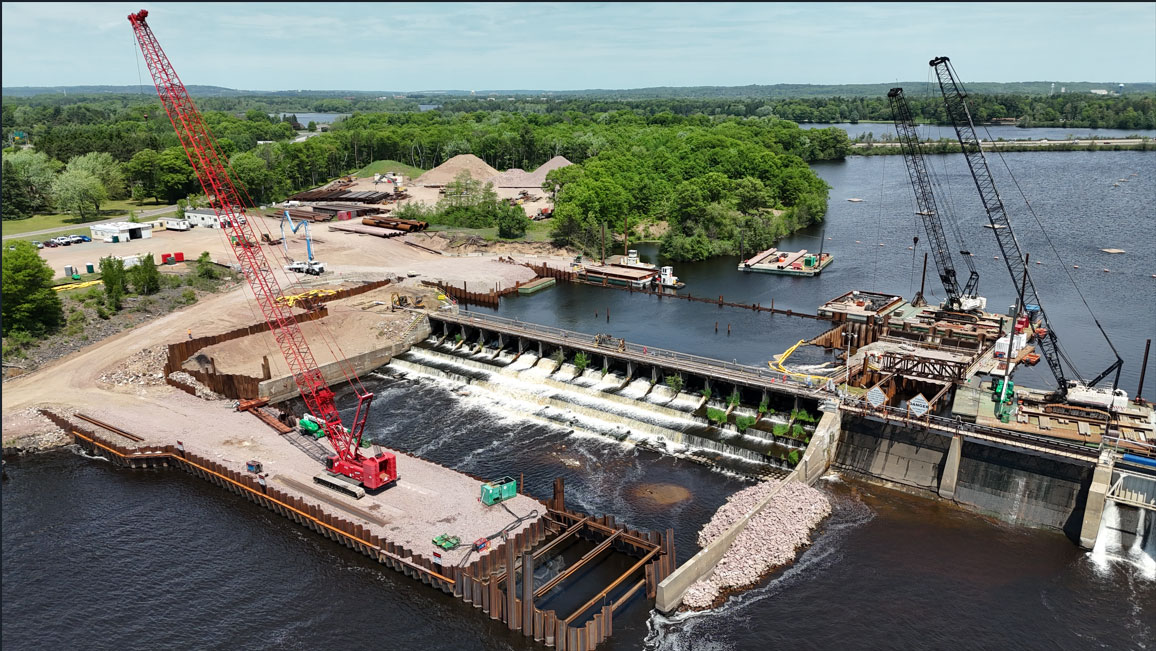
More than a century later, work is underway to modernize the Rothschild Dam.
An Enduring Legacy
The mill continued to grow, while the 1,800-plus acre Lake Wausau became a lasting tourism asset for boating, fishing and other outdoor recreation.
Today, the mill’s legacy as a vital regional employer continues with hundreds of workers generating hundreds of millions annually to the regional economy. Some employees are third and fourth generation workers, demonstrating the mill’s lasting role in the community.
Domtar is working to bring the Rothschild Dam into its next chapter. Work is underway to modernize the 276-foot Timber Crib Spillway to preserve the lake’s recreational economy while supporting flood control, public safety and continued economic development.
This article was crafted using information from “D.C. Everest to Domtar: A Century of Tradition.” You can read the full book on our Our Story page.